

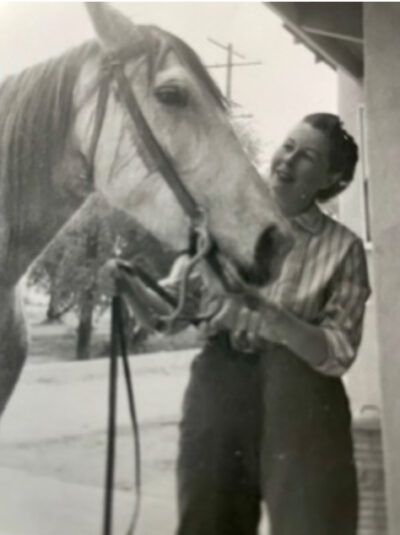
In my mind, my mother’s death has always been a cold case. But technically, it isn’t. There was no criminal investigation left open, no detective continuing to search for answers, and no unresolved case waiting to be solved. Her death was ruled a suicide within hours, before her body had even been removed from our home.
Within days, newspaper articles appeared, offering conflicting accounts of what had happened. And just like that, my mother’s death was considered settled. But it was never settled for me.
For more than six decades, I have believed that my mother was murdered. That belief has lived alongside the grief, anger, unanswered questions, and fragments of information I have gathered throughout my life. I cannot prove what happened to her. I do not know every detail of her final moments.
But I have never been able to accept the official conclusion.
The Investigation That Never Happened
For years, I searched for records that might explain what happened on the night my mother died in 1963.
On or about April 18, 2025, I spoke with the San Bernardino County Sheriff’s Department. They confirmed that, particularly given the recordkeeping practices in 1963, the absence of investigative records meant that no investigation had taken place. There were no investigative records to uncover because, as the department explained to me, there had never been an investigation. No documented interviews with neighbors. No record of my father being questioned about his whereabouts. No evidence of investigators pursuing other possible explanations for her death.
My mother’s death had been classified as a suicide without the criminal investigation I believe her circumstances warranted.
That confirmation was devastating.
How could a woman’s death be considered resolved when the circumstances surrounding it had never been fully investigated?
I have asked myself that question countless times.
I have also spoken with the Sheriff’s Department about the possibility of revisiting her death. I was told that new information would be required before an investigation could be opened.
After more than six decades, I recognize how difficult that would be. Time has taken witnesses, memories, and opportunities that cannot be recovered.
The possibility of finding answers grows more remote with every passing year. And yet the questions remain.
Someone Knew Something
I have always believed that someone knew what happened to my mother that night.
Perhaps several people knew something. Perhaps they knew only pieces of the story. Perhaps someone knew far more than they ever admitted.
I have spent much of my life wondering whether there was a person who knew the entire truth and chose to remain silent.
If my mother was murdered, as I believe, then someone knew exactly how she died.
Someone knew what happened in her final moments. And someone carried that knowledge through the years.
I have never been able to reconcile the possibility that someone took my mother’s life and was never held accountable. People are generally not very good at keeping secrets. My family, however, was extraordinarily good at it. Over the years, people talked. I learned things that had been deliberately withheld from me throughout my childhood. Some relatives seemed uncomfortable carrying the burden of what they knew.
Others remained silent.
No one in my family openly challenged my father’s insistence that certain matters remain secret. Even after his death, that silence continued.
I had hoped that someone, somewhere, would eventually reach a point where the burden of secrecy became greater than the fear of telling the truth. That day never came.
Before my father’s death, I had finally reached a point where I was ready to confront him about the questions that had haunted me for years. I told him that when he returned from his fishing vacation, I wanted to sit down and talk with him. He knew the conversation was coming. I remember the look in his eyes when I told him.
Something in his expression made me believe he understood what I intended to ask. But that conversation never happened. My father never returned from his fishing vacation. He drowned under circumstances I have always considered suspicious. I know the story that was told about his death. I know what his death certificate says. But there are details that have never fit together, questions that remain unanswered, and circumstances I intend to explore more fully another time.
I have often wondered whether the prospect of our impending conversation weighed on him.
What I do know is that I had finally found the courage to confront him about the questions I had carried for so long. And before that conversation could take place, he was gone.
Once again, I was left with silence.
I grew up angry. At times, I am still angry.
Angry that my mother died so young. Angry that questions went unanswered. Angry that the adults who might have helped me understand what happened were forced to choose between telling me the truth and remaining part of my life.
My father demanded their silence. Those who wanted to maintain a relationship with me understood that speaking openly could mean losing access to me altogether. And so they remained silent. I understand the impossible position they were placed in. But understanding their reasons has never erased the pain of growing up surrounded by people who knew things about my mother’s death that I was not allowed to know. I was left to spend much of my life searching for a truth that may never be found.
A Television Episode That Brought Everything Back
On February 16, 2026, I watched an episode of Dateline titled Behind Door 813.
I had no idea how deeply it would affect me.
The episode introduced me to Sheila Wysocki, a suburban mother who became a private investigator while seeking answers about the unsolved murder of her college roommate.
I was struck by her determination to keep asking questions and searching for evidence when others had accepted that the answers might never be found.
As I watched, I found myself thinking about my mother. About the gunshot wound to her heart. About the official ruling of suicide. And about the questions I had carried since I was nine years old.
The episode prompted me to revisit something that has troubled me for decades: the physical circumstances of my mother’s death.
I have long questioned whether she could have inflicted the fatal gunshot wound herself.
Self-inflicted gunshot wounds to the heart are uncommon, although they are medically possible.
Whether a particular wound was self-inflicted depends on evidence such as the firearm, wound characteristics, trajectory, and circumstances at the scene. These are precisely the kinds of details I wish had been thoroughly examined and documented in my mother’s case.
The episode raised questions in my mind about the position of the firearm, the physical movements involved, and whether the official conclusion had been supported by sufficient evidence.
I could not stop thinking about it.
I have read that women have historically been less likely than men to use firearms in suicide deaths, although firearms remain a significant method of suicide among women.
I also understand that statistics cannot determine what happened in any individual case.
Still, the circumstances of my mother’s death have never made sense to me.
And watching Sheila’s story brought all those doubts rushing back.
The pain and horror of losing my mother came flooding in. It was as though no time had passed. Suddenly, I was nine years old again. A little girl whose mother was gone.
A little girl who did not understand what had happened. A little girl who would spend much of her life searching for answers.
Nine Short Years
I had only nine years with my mother. Nine short years.
My memories of her are precious, but they are not always clear.
Some arrive in fragments—a voice, a smile, a familiar gesture, a moment of laughter.
Others are hazier.
There are times when I cannot be certain whether I am remembering something I personally experienced or recalling a story that someone else told me so many times that it became part of my own memory.
I was simply too young to preserve everything.
Think about your own childhood.
What is your earliest memory?
How old were you?
Can you remember specific conversations, ordinary afternoons, or the way someone looked at you when you were nine years old?
Perhaps you can recall certain moments vividly, while others have disappeared entirely.
That is how memory often works. We remember fragments, feelings, and sometimes the smallest details, while entire stretches of our lives remain beyond our reach.
I remember how safe I felt with my mother. I remember her laughter. I remember her love.
But I cannot remember the answers to the questions that have followed me for more than sixty years.
And perhaps that is one of the cruelest parts of losing her so young. I lost not only my mother but also the opportunity to ask her about her life, her happiness, her struggles, and the circumstances that led to her death.
I have spent decades trying to piece together a story that other people seemed unwilling to tell. I know that my belief about her death is not proof of what happened.
I know that questions, however persistent, are not evidence. But I also know that an official ruling did not bring me peace, and the passage of time has not brought me closure.
I may never know the truth about my mother’s final moments.
What I do know is that she lived.
She loved.
She was my mother.
And whatever happened on the night she died, her life deserved to be remembered as something far greater than the circumstances of her death. Her story did not end with a ruling on a death certificate. It lives on in the daughter who has never stopped asking questions.
Related Resources








Leave A Comment
You must be logged in to post a comment.